![]() |
| White to move |
![]() |
| Micromaster - Sudav, 2026 |
![]() |
| White to move |
![]() |
| Micromaster - Sudav, 2026 |
![]() |
| Eintalu - Reich, Worldchess 2025 |
![]() |
| White to move |
![]() |
| Mikromeister - Axumzs, CHESSCom 2024 |
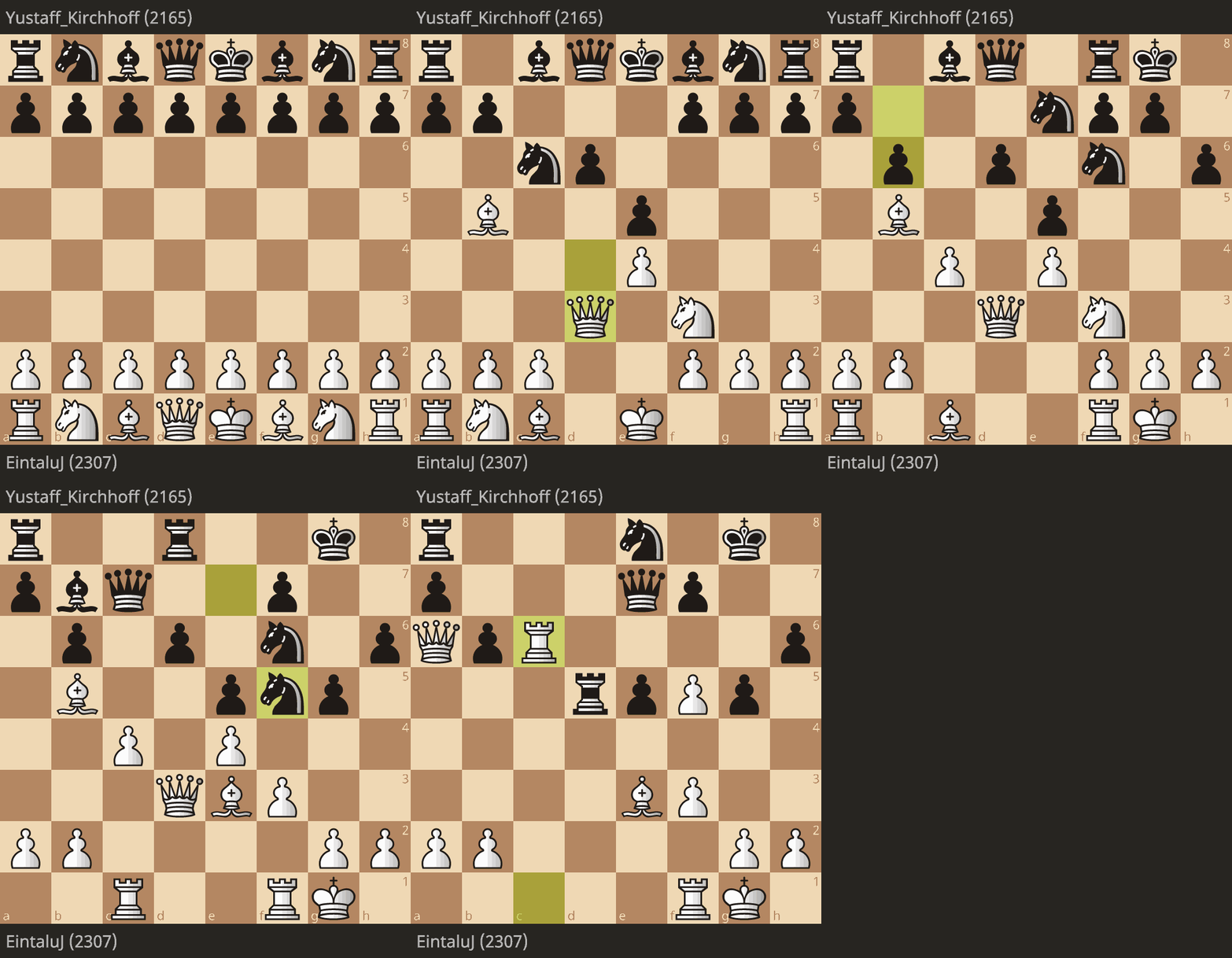
OK. I have received a puzzle rating above 3400. One day, it was 3448.
I shall stop solving CHESSCom puzzles from now on.
The reason is the poor quality of the puzzles with higher ratings. The rating points and the target times are also not well-tuned.
Yesterday, I got Kubbel's endgame study as a "tactics puzzle" to solve with the target time of 30 seconds.
Today, I got several messy positions as "tactics puzzles".
The last "puzzle" was not convincing at all. It looked somewhat like an attack with several options to continue that attack at several points.
It is evident that no human being has ever checked these positions and their solutions; there is too much trust in computer algorithms.
The themes of the puzzles are too often highly misleading, too.
By the way, other chess platforms have similar features.
![]() |
| CHESSCom puzzle rating 3448 |
![]() |
| White to move and win |
"It is a study by Kubbel, BTW."
In the 1962 game Keres—Benko, Benko made a grave mistake 30...Bb8xg3??, and the following position was on the board (see below). Then, Keres also blundered, and Benko again made a mistake. Finally, Keres still won the game.
Can you win the position after 30...Bxg3??
![]() |
| Keres - Benko 1962. White to move. |
If you are not a grandmaster, you may expect that if you do not move the pieces on the board and if you try to spend only 10 minutes on the solution, you will fail somewhere.
Thus, relax and take it as a correspondence chess position: PUZZLE.
On Chesstempo's tactics section, this puzzle has the number 143468.
A HINT: After the obvious 31 Qxg3! consider the replies 31...Qd5 and 31...Qe4.
In the present post, the Apronus chess software was used.